

As the GCC continues to experience growth, ambitious national transformation agendas, increasing market uncertainty, and the disruptive force of AI, organizations are being pushed to rethink how they operate and organize themselves. Yet despite significant investment in restructuring and operating model transformations, research suggests that the majority of organizational redesign efforts fail to deliver their intended outcomes.
Against this backdrop, we spoke with Rani Salman, the Managing Partner of Caliber Consulting and an advisor to organizations across the GCC who has led over 100 organization redesign projects, about the most common mistakes organizations make when redesigning themselves and what leaders and practitioners should do differently.
In your experience being part of over 100 organization design projects, why do so many redesign efforts fail?
For me, one of the biggest issues with organization design is that the field still has not been properly codified. It is still practiced too much as an art, and not enough as a science.
Other management disciplines, such as HR, strategy, business process management, and organizational excellence, have a wide range of established frameworks, tools, and approaches. In strategy alone, frameworks such as SWOT, strategy maps, Porter’s Five Forces, and the Balanced Scorecard that many practitioners are aware of and utilize.
But with organization design, unless someone is truly immersed in the field, I would not assume they know what a structured approach looks like, what methodology to follow, or which frameworks and tools to use.
The common joke in the field is that many redesign initiatives often amount to a CEO or business leader sketching a new organization chart on the back of a napkin and then asking HR, OD, or Strategy to implement it.
That is why one of our purposes at Caliber Consulting, both as a consulting firm and as a training academy, is to help carry the torch of organization design and promote it as a science balanced with a little bit of art.
Now stemming from this capability gap, and to answer your question more precisely there are other key contributing factors. We estimate that around 63% of organization redesign initiatives fail to deliver their intended outcomes.
Some of the most common reasons include too much design around people, over indexing structure as the root-cause and consequently solution to business problems, poorly managing the human side of change, and misalignment and lack of clarity on strategic direction.
In organization design, we often hear the rule “don’t design around people.” What does that actually mean?
I think that statement needs to be nuanced. Organizations are ultimately made up of people coming together to deliver work which achieves certain business outcomes (although AI is changing this definition rapidly). So yes, organization design must be fit for the people, capabilities, and leadership you actually have, otherwise it won’t work.
The issue is when the leading input to the design process is people and it becomes too personality driven. In other words, starting first with specific individuals and then building roles and structure around them.
The better approach is to start with strategy and the consequent work that needs to be done, then define capabilities, roles and structure required. Only after that should you look at how people fit into those roles. Defining that strategy and core work and value chain is often defined as the operating model (although there are many different interpretations of what this means) which is a pre-requisite to the organization design.
Personality-driven structures are very fragile and susceptible to future changes. Any change in personnel can require the structure to be overhauled.
So “don’t design around people” does not mean ignore people. It means don’t lead your design as people with the first input, and consequently build fragile structures around personalities. Good organization design should outlast any one individual.
From a GCC perspective, where do organizations have the greatest opportunity to improve their organization design practices?
For centuries, the organization chart has been the default way of representing the organization. It carries significant weight because it reflects power, authority, reporting lines, and influence. But an organization is far more complex than the boxes and lines shown on a chart. It is a living system made up of people, capabilities, processes, technologies, incentives, governance, culture, and ways of working.
This is why treating organization design as a chart-redrawing exercise is so limiting. As the saying goes, focusing only on the org chart is like trying to stop a ship from sinking by rearranging the deck chairs.
In the GCC, there needs to be a shift in how organization design is understood and practiced. Too often, redesign is reduced to moving boxes, changing reporting lines, merging departments, or redefining mandates and responsibilities. While these elements matter, they are only part of the picture.
True organization design requires a systems view. It means understanding how all parts of the organization fit together and how changes in one area affect the rest of the system. This systems perspective is critical for three reasons.
First, structure alone rarely delivers transformation. Our research shows that organizations are three times more likely to succeed when they use a complete set of design levers, rather than relying only on structural changes.
Second, every structural change creates ripple effects. A new structure may require changes to processes, decision rights, incentives, capabilities, technology, leadership behaviors, and culture. Without this broader view, the organization may look different on paper but operate exactly the same in practice.
Third, a systems approach helps identify the real root causes behind the redesign. Many organizations redesign because they want to improve agility, reduce silos, increase accountability, become more customer-first, or improve efficiency. But these issues are rarely caused by structure alone.
For example, if the objective is to break down silos and become more customer-focused, merging departments or changing reporting lines may help, but it will not be enough. Silos are often reinforced by misaligned incentives, competing objectives, fragmented processes, weak collaboration mechanisms, and technologies that do not support cross-functional work. To address the issue properly, the organization may need shared goals, stronger collaboration routines, better governance, more integrated processes, and a culture that rewards enterprise-wide thinking.
In other words, organization design is not about creating a better-looking chart. It is about designing a system that enables the organization to deliver its strategy, operate effectively, and adapt over time.
What are some other key organization design shifts GCC organizations need to make?
A pattern we often see in the GCC is the frequency of restructuring. Organizations in the region tend to restructure at a much faster pace than may be necessary. Some of this is understandable and even warranted. The GCC is a high-growth, fast-developing, and highly dynamic region, with major transformation agendas, national visions, market shifts, and ambitious institutional reforms. In that context, organizations naturally need to adapt quickly.
However, the frequency of restructuring is often too high. In many cases, restructuring becomes the default response to almost every performance issue, strategic shift, leadership change, or operational challenge. It becomes the “lever of choice” even when the real issue may not sit in the structure itself.
When structure is used as the primary solution for every problem, organizations can fall into a cycle of constant redesign. This creates disruption, fatigue, uncertainty, and confusion. Employees spend more time adjusting to new reporting lines, roles, and mandates than actually improving performance. Over time, the organization may become better at restructuring than at building the underlying capabilities, behaviours, and management systems needed to perform.
There also needs to be greater adoption of more non-traditional and new age organizational forms. Many organizations in the region still operate through traditional, centralized, and hierarchy-heavy structures. While these models can provide control and clarity, they can also slow decision-making, limit collaboration, and reduce agility, especially in fast-moving environments.
Newer organizational models tend to place more emphasis on decentralization, empowered teams, cross-functional ways of working, dynamic role mobility, work-to-flow talent pools, self-management, and faster decision-making closer to the customer or the work. These models are not about removing structure. They are about creating structures that are more adaptive, responsive, and fit for the pace of change.
This is not to suggest that such models do not already exist in the GCC. Some organizations are applying them very effectively and are setting strong examples for the region. However, more broadly, there is still an opportunity to move away from overly rigid, centralized structures and toward more agile organizational models.
Finally, with AI becoming a major force in business transformation, how do you see it impacting organization design?
I think AI will impact organization design in two major ways.
First, it will impact the process of design itself. Today, a typical organization design exercise starts with an assessment of the current state. This usually involves benchmarking, interviews, surveys, performance data analysis, process reviews, and other diagnostic activities. AI can significantly augment this process by helping organizations analyze large volumes of data, identify patterns, surface pain points, compare scenarios, and generate design options much faster than before.
However, the bigger impact may be in the conception and testing of new designs. With AI and digital twins, organizations can create replicas or simulations of their operating model and test different design choices before implementing them.
For example, they can simulate the impact of changing reporting lines, centralizing or decentralizing activities, shifting decision rights, or introducing new roles. This allows leaders to better understand the likely consequences of a design before making disruptive changes in the real organization.
Second, AI will impact how organizations actually look and are organized. We should not be surprised to see companies in the future that are made up of one founder and an army of AI agents. We should also not be surprised to see entire sales, customer service, finance, marketing, or operations functions supported, or in some cases largely delivered, by AI agents.
I still think that the net impact AI will not make us lose jobs. Every major technology shift has done this. When automobiles scaled, many jobs linked to horses and carriages declined. When e-commerce grew, many traditional retail roles were disrupted. When electricity became widespread, demand for certain roles linked to candles, gas lighting, and steam-powered systems declined.
AI will be no different in that sense. Some jobs will disappear, some will change, and new jobs will be created, but the net impact in terms of value creation and job creation will be positive.
The difference is that AI feels more profound because it is not only replacing physical labor or improving productivity. It is entering the space of knowledge work, judgment, coordination, analysis, and even decision-making. That said, we have to be humble when predicting the future, because the full consequences of any major technology are always difficult to foresee.
Finally, I think many discussions in the region still focus too heavily on AI as a technology issue, and don’t put enough emphasis on the structures, capabilities, governance, needed to enable it. The bigger question is not only which AI tools we adopt, but how we build AI-first operating models.
AI will reshape workflows, decision-making, job design, capability requirements, management practices, and team structures. Organizations will need to rethink which activities should be automated, which should remain human-centered, and how people and intelligent systems will work together.
The leaders who gain the greatest advantage from AI will not simply be those who implement the most advanced technology. They will be those who redesign their organizations around AI and build operating models that are truly AI-enabled.
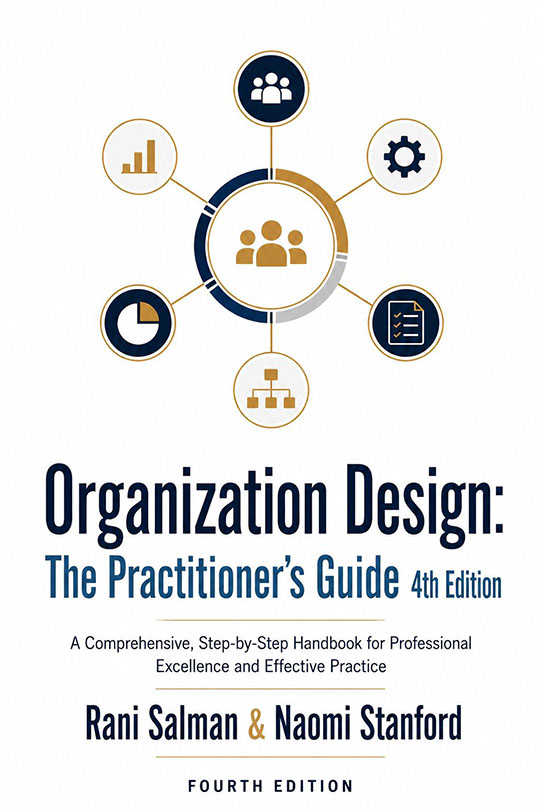
Organization Design: The Practitioner’s Guide
Many of the points discussed with Rani Salman are explored in his upcoming book, ‘Organization Design: The Practitioner’s Guide’.
The fourth edition, co-authored with organization design thought leader Dr. Naomi Stanford, breaks organization design down into a more practical and scientific discipline. It also updates the field for today’s realities, including the impact of AI, the rise of non-traditional organization models, and the evolving ways organizations need to be designed for the future.
About Caliber Consulting
For organizations seeking to improve effectiveness, agility, and performance through better organization design, Caliber Consulting provides advisory services, executive education, and practical frameworks tailored to today’s business challenges.
To learn more about the firm’s work, upcoming book, and latest insights, contact the team or visit its website.