
Four leading experts in the world of organizational and human resources management – William J. Rothwell, Behnam Bakhshandeh, Ethan S. Sanders and Rani Salman – have joined forces to launch ‘Beyond Traditional Performance Management’, a new book that sets out how organizations can reinvent their performance management cycles.
In a business environment where talent, agility and accountability have become strategic imperatives, few organizational processes remain as widely disliked as the performance review. Illustrating this, nearly 66% of employees are strongly dissatisfied with their organization’s performance reviews, and many view them as an “absolute waste” of time.
As a result, employees often leave performance reviews feeling deflated rather than developed. And in many organizations, including across the Middle East, mediocre talent still seems to advance while stronger performers are overlooked.
In ‘Beyond Traditional Performance Management’, the authors explore this long-standing issue, pinpointing why traditional performance management systems continue to disappoint, and offer a fresh and practical perspective on what organizations can do instead.
“Performance management has too often become a ritual rather than a results engine,” said Dr. William J. Rothwell, renowned author, management guru in HR, and author of close to 200 books on human resources, talent development and organizational performance.
“This book was written to help organizations move from annual judgment to continuous improvement, from compliance to capability, and from performance review as an event to performance management as a system.”
Designing the modern performance system
According to the authors, the problem is not that performance management lacks importance. The problem is that the systems themselves are often poorly designed, inconsistently implemented and disconnected from the real work of strategy execution, coaching, development and culture building.
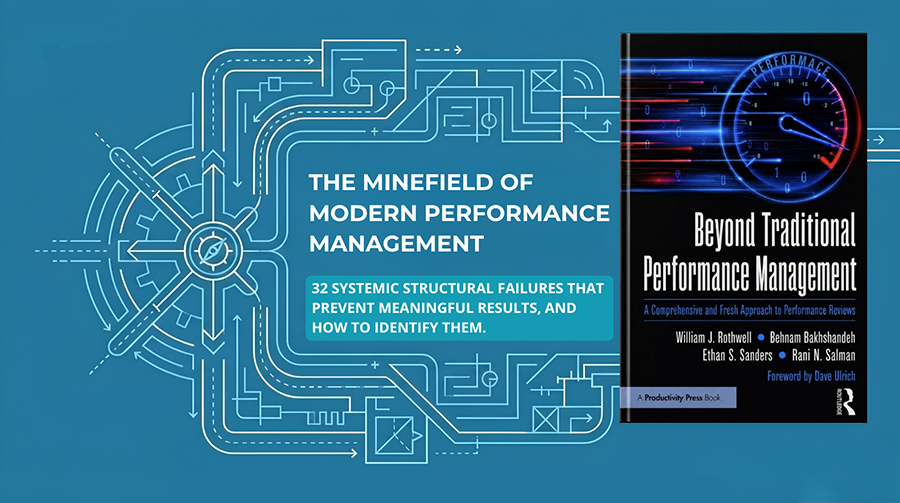
The book presents 32 critical challenges that undermine performance management systems and provides practical remedies for each challenge. The authors examine why reviews fail, how feedback can become more meaningful, how managers can be better equipped to coach performance, and how organizations can move toward a more future-ready model grounded in continuous feedback, skill development, employee well-being and purpose-driven leadership.
“Organizations can no longer rely on performance reviews designed for a different era,” said Behnam Bakhshandeh, PhD, executive coach, author, consultant, and organizational development practitioner.
“This book challenges conventional thinking and offers a practical, forward-looking framework that places continuous feedback, employee development, well-being, and purpose-driven leadership at the center of organizational success.”
The authors emphasize that performance management should not be treated as a once-a-year exercise, but as a living system. They highlight the importance of regular conversations, clearer accountability, stronger manager capability, better alignment between individual and organizational goals, and more thoughtful approaches to development and recognition.
Another caveat lies in treating performance management as “simply a HR process”, said Ethan S. Sanders, author, performance expert, ATD faculty member, and award-winning talent development leader.
“It is one of the most important operating systems in an organization. When goals, feedback, coaching and development are aligned, people know what matters, managers know how to support them, and the business becomes more capable of delivering results.”
The authors additionally argue that modern performance management should do more than assess past results. It should clarify expectations, reinforce strategy, develop talent, enable better conversations, support well-being and help organizations make fairer decisions about growth, rewards and advancement.
‘Beyond Traditional Performance Management’ also looks ahead to the future of performance management, noting that artificial intelligence (AI) is expected to play a growing role. AI agents may increasingly support managers and employees by analyzing performance patterns, identifying development needs, generating timely feedback, supporting coaching conversations, and helping organizations move from episodic reviews to more continuous, data-informed performance enablement.
Rather than replacing the human element, the authors position technology as a potential enabler of better conversations, stronger insights, and more personalized development.
The Middle East lens
While the book takes a global perspective to performance management, one of its authors is based in the Middle East: Rani Salman, Managing Partner of Caliber Consulting’s Middle East practice, author, and consultant known for his work in strategy, organization design and people transformation.
He said the book’s launch comes at a highly relevant time for organizations in the Middle East, where rapid transformation agendas, national visions, localization priorities and talent development ambitions are intensifying pressure on organizations to rethink how they define, measure and enable performance.
“Organizations are under pressure to become more adaptive, more human-centric and more data-informed. Yet many in the region still rely on performance processes designed for a more stable, hierarchical and compliance-driven era,” he said.
“The warning sirens are impossible to ignore,” Salman added. “Too many organizations are investing enormous effort into performance management systems that people do not trust, managers do not use well, and leaders do not see translating into better performance.”
“Those that want to thrive in the next decade cannot rely on performance systems built for the last one. The future belongs to organizations that can align performance, learning, feedback, AI-enabled insight, and purpose in a way that helps both people and enterprises grow.”
Adding weight to the publication, the foreword is contributed by Dave Ulrich, widely regarded as one of the most influential voices in HR, leadership and organizational capability. His work has shaped the HR profession globally, and his foreword helps frame the importance of performance management as a core mechanism for building organizational capability and delivering value.
The book is aimed at executives, CHROs, managers HR leaders and practitioners, and management consultants. ‘Beyond Traditional Performance Management’ is available through Amazon and Routledge/Productivity Press.