
Strategic decision making has never been more important for GCC organizations.
Across Saudi Arabia, the UAE, and the wider Gulf region, leaders are navigating unprecedented transformation. Vision-led national agendas, digital disruption, workforce nationalization, evolving customer expectations, and shifting economic conditions are creating extraordinary opportunities. They are also making strategic choices significantly more difficult.
Every organization reaches moments where multiple opportunities appear attractive, resources are limited, and leaders disagree on the best path forward. In those moments, the true test of strategic leadership is not identifying more opportunities. It is making deliberate choices about where to focus, where to compete, and where not to invest.
The organizations that thrive during periods of uncertainty are rarely those pursuing the most initiatives. They are the ones making the clearest choices and aligning their people, capabilities, and resources behind them.
Why Strategic Decision Making Matters More Than Ever
Senior leaders across the GCC are operating in one of the most complex business environments the region has experienced.
National transformation program are reshaping industries. New markets are emerging. Digital technologies are changing business models. At the same time, organizations are expected to accelerate growth, strengthen national talent pipelines, improve organizational effectiveness, and deliver measurable business outcomes.
The instinct in such an environment is often to move faster and pursue more opportunities. Yet ambition without focus is not strategy.
When organizations attempt to do everything, they often end up doing many things reasonably well and nothing exceptionally well. The real question is not which opportunities to pursue. It is which opportunities can be pursued well enough to create sustainable competitive advantage.
The Strategic Performance Gap Is Growing
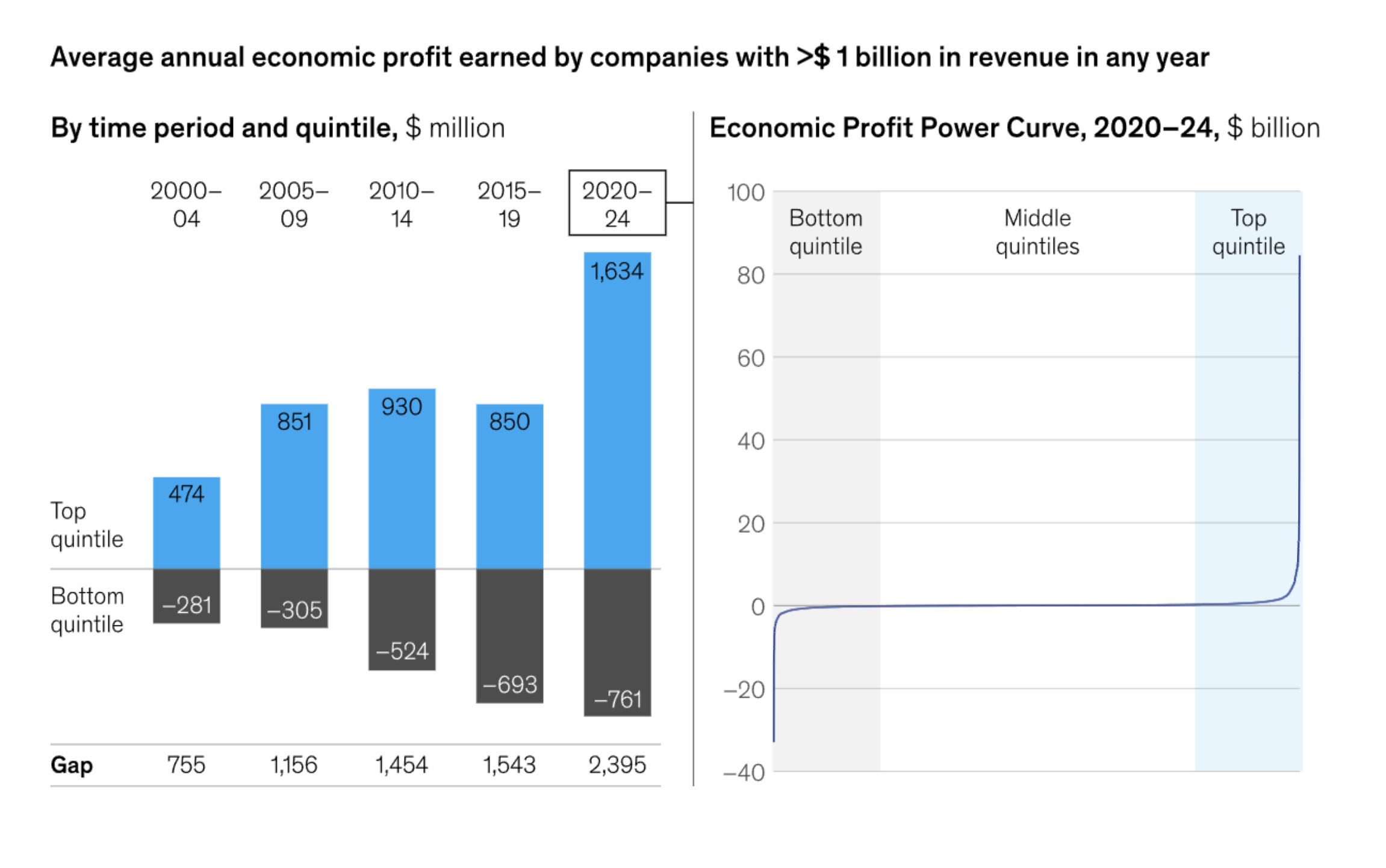
Recent global research highlights a concerning reality. Only 21 percent of organizations report that their strategies pass four or more quality tests, representing a significant decline compared with fifteen years ago.
At the same time, the gap between high-performing and low-performing organizations continues to widen dramatically.
The top 20 percent of companies now capture nearly 90 percent of economic surplus, while the bottom performers destroy a comparable amount of value.
For leaders, the message is clear:
The rewards for effective strategy execution have never been greater. Neither have the consequences of poor strategic choices.
This trend is particularly relevant in the GCC, where organizations are making substantial investments in business transformation, digital transformation, organization design, and operating model transformation initiatives.
GRAPHIC 1: Economic Profit Power Curve: the gap between top and bottom quintile performers has grown from $755 billion in 2000-04 to $2.395 trillion in 2020-24
Executive Insight
Rising uncertainty is not a temporary challenge. It has become a permanent feature of the operating environment. The organizations that thrive are not those waiting for certainty. They are those making better strategic choices despite uncertainty.
GCC Leaders Are Confident. The Environment Is Not.
Research across the region reveals an interesting paradox.
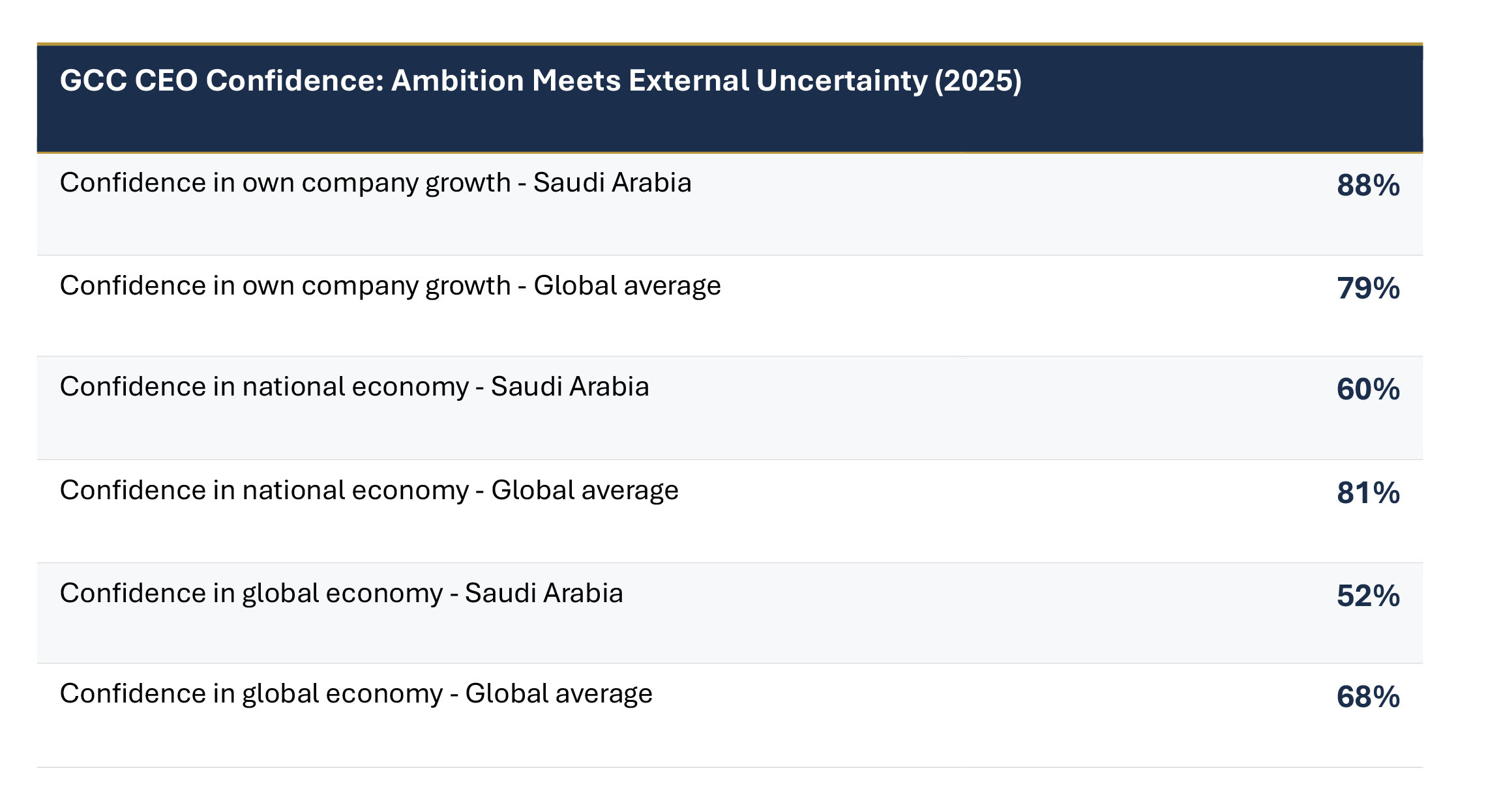
Business leaders in Saudi Arabia demonstrate significantly higher confidence in their organizations’ growth prospects than the global average. Yet confidence in both the national and global economic environment remains considerably lower.
This gap between internal ambition and external uncertainty is precisely where strategic discipline becomes a competitive advantage.
Organizations cannot control economic conditions, geopolitical shifts, or market disruptions.
They can control the quality of their strategic choices.
Leaders are confident in their own organizations while navigating an external environment they feel considerably less certain about.That gap, between internal ambition and external uncertainty, is precisely the context in which the discipline of strategic choice matters most.
Why Leadership Teams Often Get Strategy Wrong
One of the most overlooked realities of strategy consulting and organization design consulting is that strategy discussions are rarely purely analytical.
They are human.
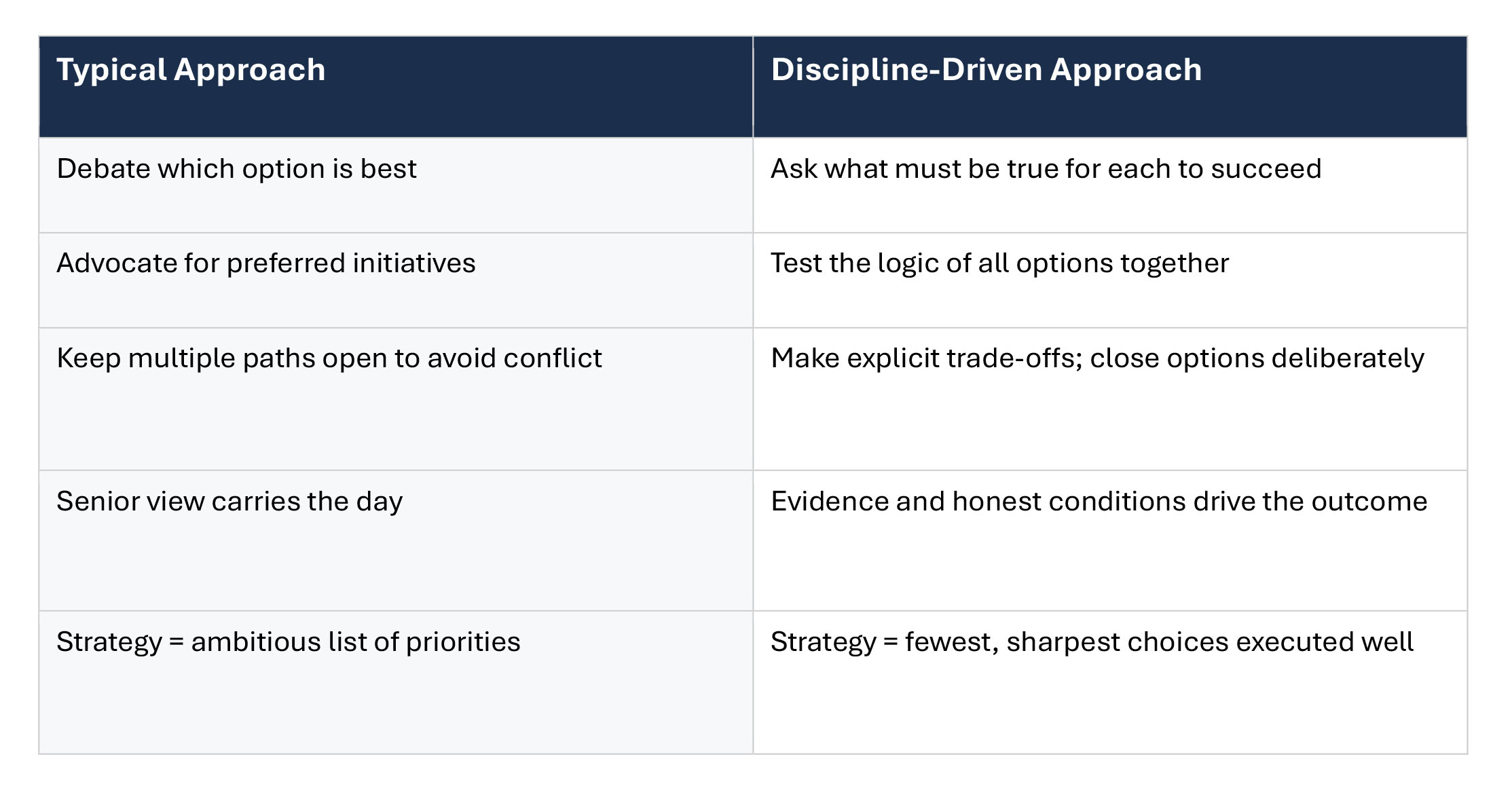
People advocate for initiatives they have invested time and energy into. Leaders are reluctant to abandon projects they helped create.Teams keep multiple priorities alive to avoid difficult conversations. In hierarchical organizations, the most senior opinion often outweighs the strongest evidence.
The result is predictable.
Instead of making clear choices, organizations create long lists of priorities. Instead of strategic focus, they create strategic overload.
Many leadership teams confuse activity with progress.
They develop ambitious plans without making the difficult trade-offs required to execute them successfully.
“Most organizations do not fail because they lack ideas. They fail because they lack the discipline to make clear strategic choices.”
The Hidden Link Between Strategy and Organization Design
This is where many organizations unintentionally undermine their own success.
Strategy does not succeed in isolation.
Even the strongest strategic direction will fail if the organization’s operating model, organizational structure, governance mechanisms, decision rights, and capabilities are not aligned to support it.
This is why organization design should never be viewed as a separate initiative from strategy.
Effective organizational design creates the structure, accountability, workflows, and leadership alignment needed to turn strategy into execution.
Without organizational alignment, strategy becomes aspiration.
Without strategy, organization design becomes an exercise in rearranging boxes on an organization chart.
The most successful GCC organizations treat strategy execution, organization effectiveness, and operating model design as interconnected disciplines.
What Real Strategic Choice Looks Like
One of the most practical approaches to strategic decision making begins with a deceptively simple question:
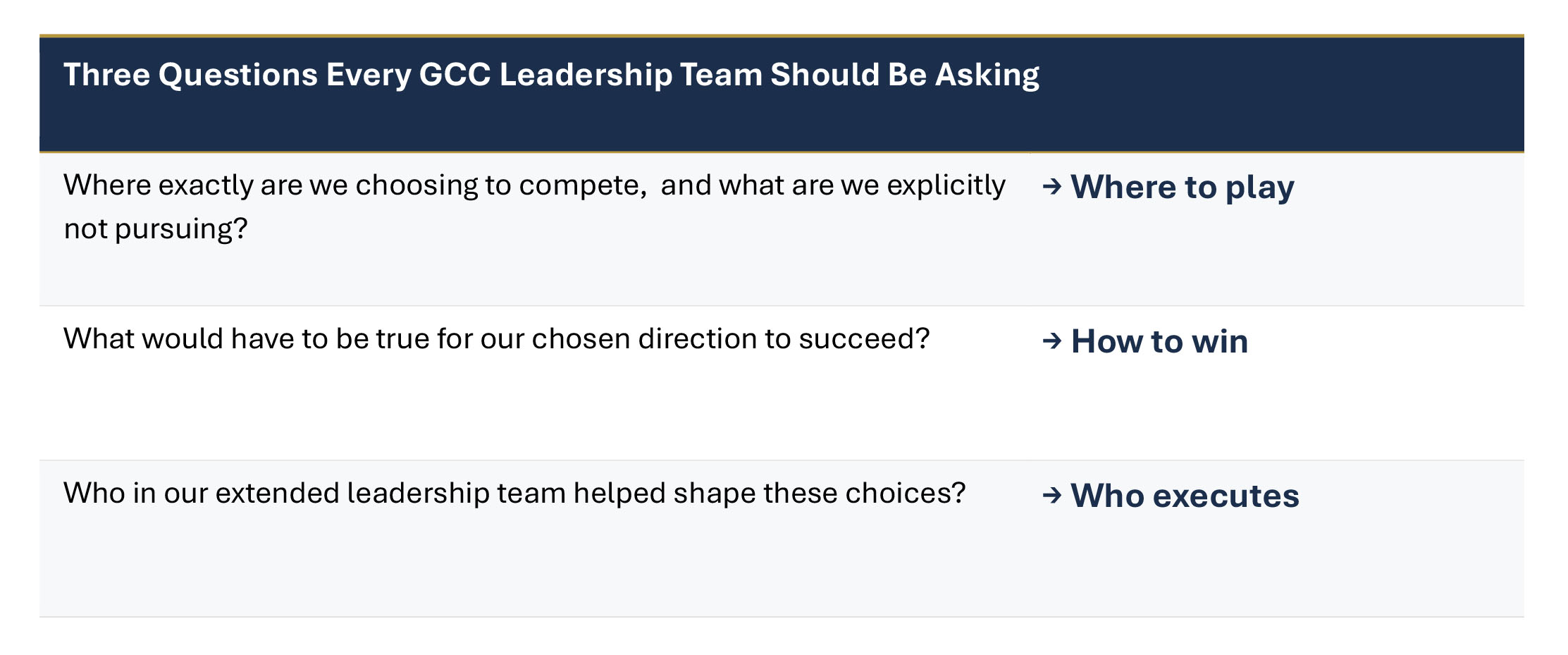
What would have to be true for this option to succeed?
This question changes the nature of the conversation.
Rather than debating which idea is most attractive, leaders evaluate the conditions required for each option to create value.
They examine:
- Market conditions
- Competitive dynamics
- Organizational capabilities
- Leadership capacity
- Resource requirements
- Workforce readiness
- Technology enablers
The Strategic Conversation: Two Modes
The most unlikely assumptions become the real test of the strategy.
If those assumptions cannot realistically be achieved, the option should be reconsidered regardless of how attractive it appears on paper.
This approach transforms strategy discussions from advocacy into inquiry and creates greater alignment across the leadership team.
The Most Strategic Word in Leadership
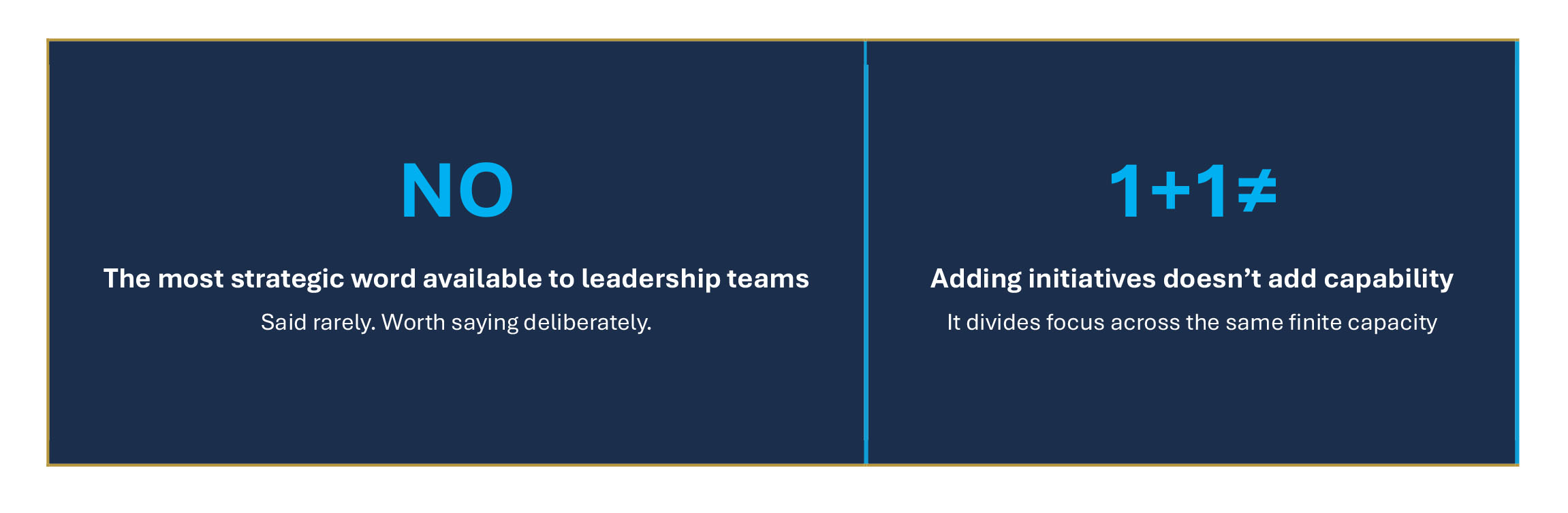
One of the most important skills a leader can develop is the ability to say no.
Not to bad ideas. Those are usually easy to reject.
The real challenge is saying no to good opportunities that fall outside the organization’s strategic priorities.
Many organizations lose momentum not because they lack ambition, but because they try to do too much at once. New initiatives are added, priorities continue to expand, and resources become spread across competing efforts. Over time, focus weakens, execution slows, and results suffer.
Without clear strategic choices, every opportunity can seem urgent. Every project appears valuable. Every proposal finds a champion.
The problem is that organizational capacity is not unlimited.
The most successful organizations understand that strategy is as much about what not to do as it is about what to pursue. They make deliberate choices, concentrate resources where they matter most, and commit to executing a smaller number of priorities exceptionally well.
Competitive advantage is rarely built by chasing every opportunity. It is built by making disciplined choices and investing deeply behind them.
Strategic Alignment Requires the Right People in the Room
Strategy is not only a process challenge. It is a leadership challenge.
When strategies fail, organizations often blame either senior executives or frontline employees.
Yet the greatest influence frequently sits with the extended leadership team.
Business unit leaders, functional heads, regional leaders, and department directors make hundreds of daily decisions about priorities, resources, and execution.
If these leaders are treated as recipients of strategy rather than participants in strategic choice, alignment suffers.
When they help shape the strategy, they become advocates for it.
They understand not only what decisions were made, but why they were made.
That understanding becomes critical for successful strategy execution, change management, and organizational transformation.
What This Means for GCC Organizations
For Strategy Directors managing multiple transformation programs, CHROs balancing workforce nationalization and leadership development priorities, and executives leading digital transformation efforts, strategic choice is not an academic exercise.
It is a daily reality.
The organizations that emerge strongest from the current wave of GCC transformation will not be those with the longest strategic plans.
They will be those that:
- Make fewer but better strategic choices
- Align strategy with organization design
- Build operating models that support execution
- Develop leadership capability at every level
- Focus resources on the highest-value opportunities
- Create clarity around priorities and accountability
In a region defined by opportunity, competitive advantage will belong to organizations with the discipline to choose.
Because strategy is not ultimately about deciding what todo.
It is about having the confidence, clarity, and leadership maturity to decide what not to do.
And in today’s environment, that may be the most valuable strategic capability of all.
Is Your Organization Set-up to Execute Its Strategy?
Many organizations have clear ambitions but struggle with execution.
Register for our complimentary Organizational Effectiveness Assessment to identify potential gaps in strategic alignment, operating model design, decision rights, leadership capability, and execution readiness.