

THE AGE OF INTELLIGENCE: A NEW GRAVITATIONAL FORCE SHAPING THE OPERATING MODEL OF THE FUTURE
AI is becoming the integral part of the operating model system. For organizations across every industry, this isn’t merely a technology upgrade; it’s a structural transformation that reshapes how strategy is defined, governance is executed, and culture is lived. The new era of AI demands not adaptation but the reinvention of processes, mindsets, and entire operating models.
An AI operating model defines how an organization orchestrates its people, processes, and technologies to deliver value in an intelligent, adaptive, and ethical way. It is not a static framework but a living system, designed to absorb complexity, scale insight, and evolve continuously.
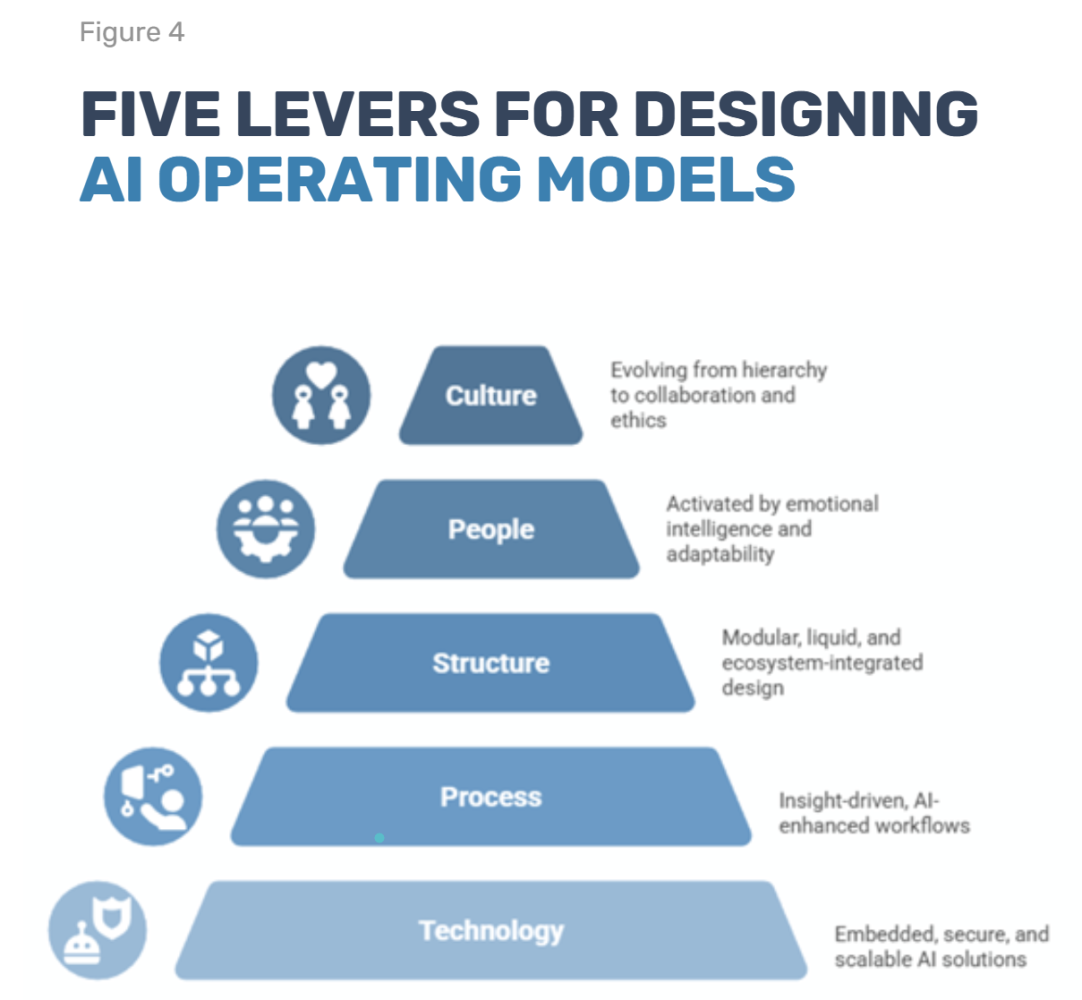
At Caliber Consulting, we see AI not as a wave to ride, but as a new gravitational force, one that reshapes the very structure of the operating model. It pulls every part of the organization (People, Structure, Culture, Process, and Technology) into a faster, smarter orbit. And just like gravity, it alters how everything moves. The organizations that thrive will be those that redesign their operating models to function within this new field of motion.
“AI is reshaping every layer of the enterprise, from decision rights and team structures to workflows and ethics. The challenge is not adoption. It’s orchestration.”
— World Economic Forum, Future of Jobs Report 2025
This is that second chance, a moment for strategic leaders to grasp how AI is redefining the operating model, and to lead that reinvention with clarity, confidence, and purpose.
THE LANDSCAPE OF INTELLIGENCE: WHERE THE OPERATING MODEL STANDS
The acceleration is real. According to the World Economic Forum’s Transforming Consumer Industries in the Age of AI, 83% of companies have ramped up their reinvention strategies over the past year. Yet no organization has fully realized AI’s potential. The depth of change goes beyond technology, it requires redefining the operating model itself. Even industry leaders are only beginning to scratch the surface.

Figure 1 shows a clear correlation between AI maturity and revenue growth. Companies in the top quartile of AI adoption, those that have begun to realign their operating models around intelligence, have achieved 18% higher revenue growth since 2019. This is not a marginal gain; it is structural evidence that a more intelligent operating model pays off.
But adoption remains uneven. Industry-level data reveals stark contrasts in AI platform investment. Sectors like telecommunications, mining, and automotive are leading the charge, while healthcare, media, and advanced manufacturing lag behind. The gap is not only in growth but in how deeply each sector has embedded AI into its operating model. The disparity is structural; and signals where momentum is building, and where transformation has yet to take hold.
THE WORKFORCE REVOLUTION
Meanwhile, the workforce is undergoing a quiet revolution, one that is reshaping the operating model. The Future of Jobs Report 2025 presents a sobering forecast: roles in data, fintech, and machine learning are surging, while routine clerical jobs are in decline. Figures 2 and 3 list the fastest-growing and fastest-declining roles between 2025 and 2030.
Rising Roles: Big data specialists, AI engineers, and UX designers are on the rise becoming essential to the new operating model.

Declining Roles: Bank tellers, data entry clerks, and telemarketers are fading.

The shift has begun — not just in roles, but in how the operating model works. The question is no longer whether to transform, but how.
SIGNALS AND BARRIERS: WHAT LEADERS MUST NOTICE TO REINVENT THE OPERATING MODEL
Transforming the operating model into an AI operating model is not a matter of adoption, it's a matter of orchestration. The signals leaders must notice are often subtle but decisive: where decision-making is slowed by legacy hierarchies, where data silos limit learning, governance lacks clarity, and where culture resists intelligent automation. These are early indicators of an organization's readiness, or resistance, to becoming AI-enabled.
The barriers are equally structural. Outdated architectures, fragmented accountability, and insufficient AI literacy can quietly erode transformation momentum. Even strong strategies falter when operating models are not designed to absorb continuous learning and algorithmic decision flows.
High-performing organizations are already redesigning their operating models to overcome these barriers: simplifying governance layers to accelerate decisions, reskilling teams to collaborate with intelligent systems, and building workflows that turn data into action.
For leaders, the real task is to turn AI strategy into operating model reality; building organizations that learn, adapt, and decide intelligently at scale.
PEOPLE: REDEFINING WORK IN THE AI OPERATING MODEL
AI isn’t replacing people, it’s redefining how they work within the AI operating model. Figure 5 outlines workforce strategies planned by employers up to 2025. The top priority is upskilling, with 85% of employers committed to developing their existing workforce. Hiring for new skills ranks second, followed by transitioning staff into new roles, combining human talent with technology and reducing obsolete roles as part of the mix.

The future of the AI operating model belongs to adaptive talent. Roles requiring judgment, creativity, and emotional intelligence will lead, while routine tasks are automated. Organizations must invest in reskilling and human-centered design to strengthen their operating model’s human core, which creates environments where people learn and grow alongside intelligent systems.
The future of work will not be built on roles alone. It will be built on reinvention, where talent is fluid, learning is continuous, and human intelligence enables the operating model and fuels enterprise growth.
Critical insight: With the half-life of a learned skill at five years and a developer’s skill-set at two, the accelerating pace of change demands constant re-skilling. Organizations must enable workers to drive their own development paths, a key enabler of the evolving AI operating model, and embrace continual learning.

Figure 6 outlines the soft and hard skills required for future ready operating models. Collaboration, empathy, adaptability, and learning agility are essential, as are digital fluency, data literacy, and the ability to turn insights into action. Intelligent enterprises embed these capabilities operating into their models, making them visible, measurable, and shared across teams.
Leadership evolves from directing activity to mobilizing potential. Leaders in the AI operating model become students, learning from every corner of the organization and from non-traditional disruptors. They build trust and alignment rather than control. The future of work will not be built on roles alone but on reinvention, where talent is fluid, learning is continuous, and human intelligence powers the operating model of enterprise growth.
STRUCTURE: THE SKELETON OF STRATEGY FOR THE AI OPERATING MODEL
Structure is the skeleton of the AI operating model. Without the right architecture, intelligence cannot scale. Rigid hierarchies and silos hinder intelligent workflows. Organizations must redesign their structures for agility, integration, and responsiveness, through modular teams, interoperable platforms, and decentralized decision-making.
CULTURE: THE ENABLER OF THE AI OPERATING MODEL
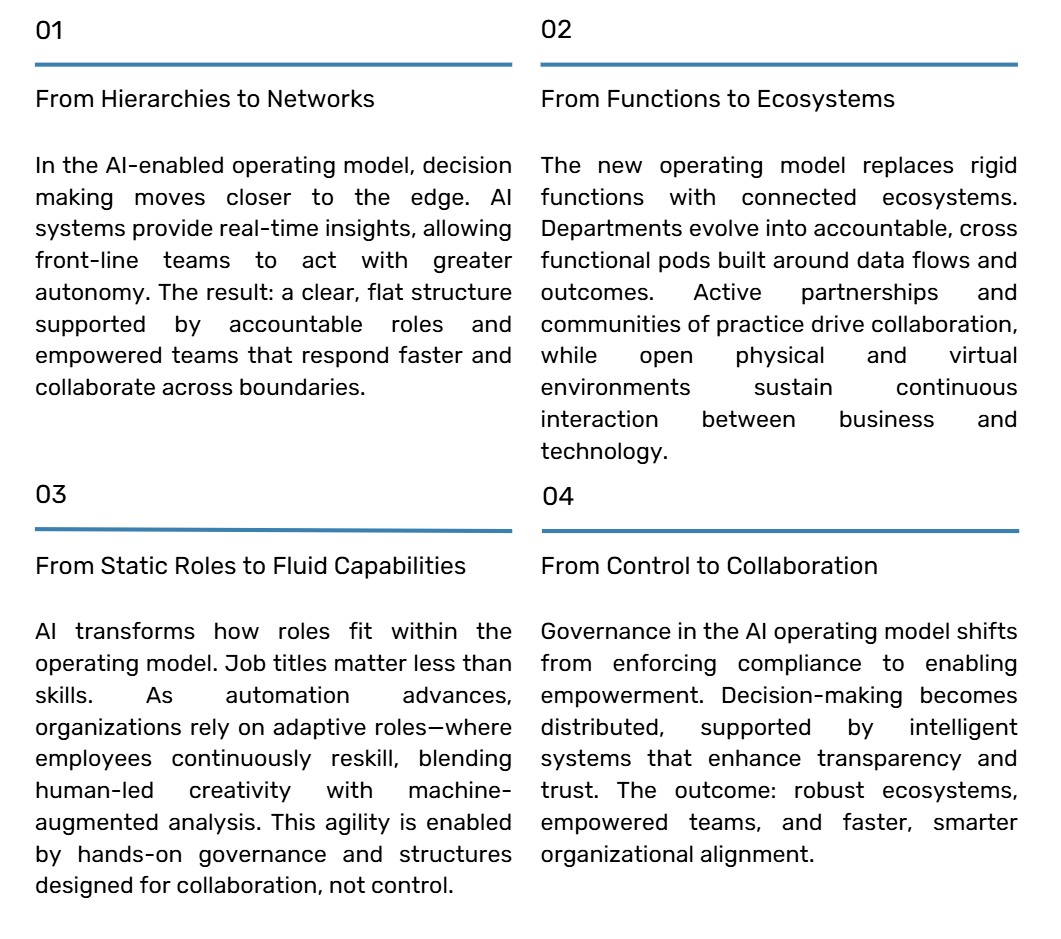
Culture is the operating system of transformation. In legacy organizations, culture is shaped by hierarchy, tradition, and compliance. Trust is built through authority. Decisions in intelligent enterprises are guided by data and shared insight, which means culture must evolve to become collaborative, transparent, and ethically aligned.
Future-ready cultures are built on inclusive decision-making, crossfunctional collaboration, and shared accountability. That means shifting from control to empowerment, from silence to visibility, from static roles to adaptive behaviors.
Once the transformation is complete, behavior must shift. Collaboration across disciplines becomes the norm. Ethical reflection is no longer reserved for policy, but becomes part of every decision. Trust is built through visibility, not hierarchy. Feedback flows freely. Learning is continuous, not episodic. Intelligence scales only when people move with it, curious, adaptive, and aligned.

The organizations that will thrive are those that treat culture as the connective tissue of the operating model: adaptive, data-literate, ethically grounded, and human at its core. When curiosity replaces certainty, empowerment replaces control, and alignment replaces hierarchy, AI becomes a catalyst for collective intelligence.
TECHNOLOGY AND PROCESSES: THE ENGINE OF THE AI OPERATING MODEL
TECHNOLOGY
Next generation technology is the enabler of the AI operating model. It must be embedded, scalable, and secure. The WEF presents a projection of tasks potentially automated or augmented by generative AI across industries. Financial services, software, and media show high exposure—but exposure is not rediness.
Organizations must build infrastructure that amplifies AI within the operating model, through data governance, platform ecosystems, integration frameworks, and secure, scalable technologies that enable intelligent operations enterprise-wide.
The World Economic Forum outlines a shift from enterprise IT to intentional technology roadmaps. Intelligent operating models do not wait for disruption; they scan, select, and integrate emerging technologies to unlock new business capabilities.
Technology is no longer the domain of IT alone.
It becomes the shared responsibility of every business unit and every employee. Workers must understand the tools they use, the data they generate, and the systems they shape. This is not a technical upgrade—it is a structural evolution of the operating model itself.
PROCESS
Processes are where the operating model meets execution. They determine how work flows, how decisions are made, and how value is created. Figure 1 shows that companies in the top quartile of AI maturity—those that have redesigned their operating models around intelligent processes—achieved 18% higher revenue growth since 2019. This advantage is not just about better tools; it reflects smarter orchestration, where processes are designed to learn, adapt, and scale.
AI-enhanced processes do not just automate tasks; they orchestrate decisions. They enable rapid iteration standardized ways and of performance-oriented experimentation, working, outcomes. These processes thrive on information transparency, allowing teams to access real-time insights and make action-oriented decisions that drive measurable impact.
To compete, organizations must evolve from rule-based to learning systems, redesigning processes to sense, respond, and adapt in real time. Embedding continuous learning and decentralizing control enable faster decisions and reinforce the agility of the AI operating model.
THE SECOND CHANCE: THE CALL TO REDESIGN THE OPERATING MODEL
AI has become the new gravitational force of enterprise—reshaping how operating models function, adapt, and deliver value. The five levers of design must now align around intelligence, agility, and ethical intent.
Leaders stand at a crossroads: do they preserve legacy operating models built for efficiency, or redesign them for intelligence, adaptability, and continuous learning?
Those who thrive will reimagine their operating models as living systems; where structures, processes, and decisions evolve as intelligently as the AI systems they employ.
The transformation is already underway. The question is not whether to redesign the operating model, but how to do so purposefully.