
The Silent Strategy Killer
How Organizational Culture Drives Strategy Execution
Think about the last major strategic initiative your organization launched. The direction was clear. The resources were committed.The leadership team was aligned. And yet, somewhere between the boardroom and the day-to-day reality of the organization, momentum quietly dissolved.Projects continued. Meetings happened. Reports were filed. But the organization never actually moved.
If this sounds familiar, the culprit is rarely the strategy itself. More often, it is an organizational culture that is misaligned with business priorities, making effective strategy execution almost impossible.
Every failed strategy has a story that senior leaders are rarely willing to tell clearly. The post-mortem focuses on execution problems, capability gaps, or a shift in market conditions. Rarely does anyone say the honest thing: the culture was pulling in a different direction, and nobody addressed it. It is one of the most consistent and costly patterns in organizational life, and the one that executives most systematically under estimate.
A 2024 analysis of business transformation across industries found that 88 percent of transformations fail to achieve their original ambitions.Research tracking change initiatives more broadly puts the failure rate at approximately 66 percent, with employee resistance and management behavior identified as the primary barrier in nearly three-quarters of those cases. What sits underneath both of these figures is almost always the same thing: a cultural environment that was not designed to support the direction the organization was trying to move in.
Why Organizational Culture Matters for Strategy Execution
The reason culture so consistently escapes serious strategic attention is that it feels intangible compared to structure, process, or technology. You can diagram an org chart. You can map a process. You can budget for a system implementation. Culture does not yield as easily to that kind of legibility, and so it tends to get treated as something that will shift naturally once the strategy is clear and the structure is in place.
This assumption is wrong, and organizations pay for it repeatedly.
Culture is not a backdrop to strategy. It is the operating environment that every strategic initiative must navigate. It shapes how people interpret priorities, make decisions under pressure, allocate attention, and treat each other when no one senior is watching. When the cultural environment rewards caution, people will find ways to be cautious even inside an initiative designed to drive boldness. When it rewards individual performance over collective outcomes, people will protect their own results even inside a structure designed for collaboration.
Think of it as a filter. Every strategic signal your organization sends, every communication, every restructure, every initiative, runs through the cultural filter before it reaches the people who need to acton it. When that filter is misaligned with the strategy, the signal degrades.The strategy does not override the culture. The culture determines which parts of the strategy actually land.
“Culture eats strategy for breakfast. But what gets less attention is that culture also determines which strategies get taken seriously in the first place and which ones quietly starve.”
The Gallup State of the Global Workplace 2026 Report puts a number on it: global employee engagement fell to 20 percent in 2025, its lowest level since 2020, costing the global economy an estimated 10 trillion dollars in lost productivity annually. Gallup’s calculation of the upside is equally striking: if organizations globally matched the engagement levels of today’s best-practice organizations, that figure reverses to a 9.6 trillion dollar gain, roughly nine percent of global GDP.
The gap between where most organizations are and where the best ones operate is not primarily a technology gap or a strategy gap. It is a culture gap.

GRAPHIC 1:Gallup State of the Global Workplace 2026 Report, Page 5: 'The Engagement SlumpContinues' — Global engagement percentage trend from 2009 to 2025 showing the decline to 20%
Why OrganizationalTransformations Fail and How to Diagnose Your Own
Most organizations that attempt a cultural shift do so in away that is structurally designed to produce the illusion of change rather than the reality of it. A new set of values gets defined. A launch event is held. Leaders make speeches about what the organization stands for. The values appear on walls, intranets, and email signatures. And then, over the following months, the daily reality of working in the organization continues largely as it did before. People adopt the new language to describe the old behaviors, and the culture absorbs the initiative without fundamentally moving.
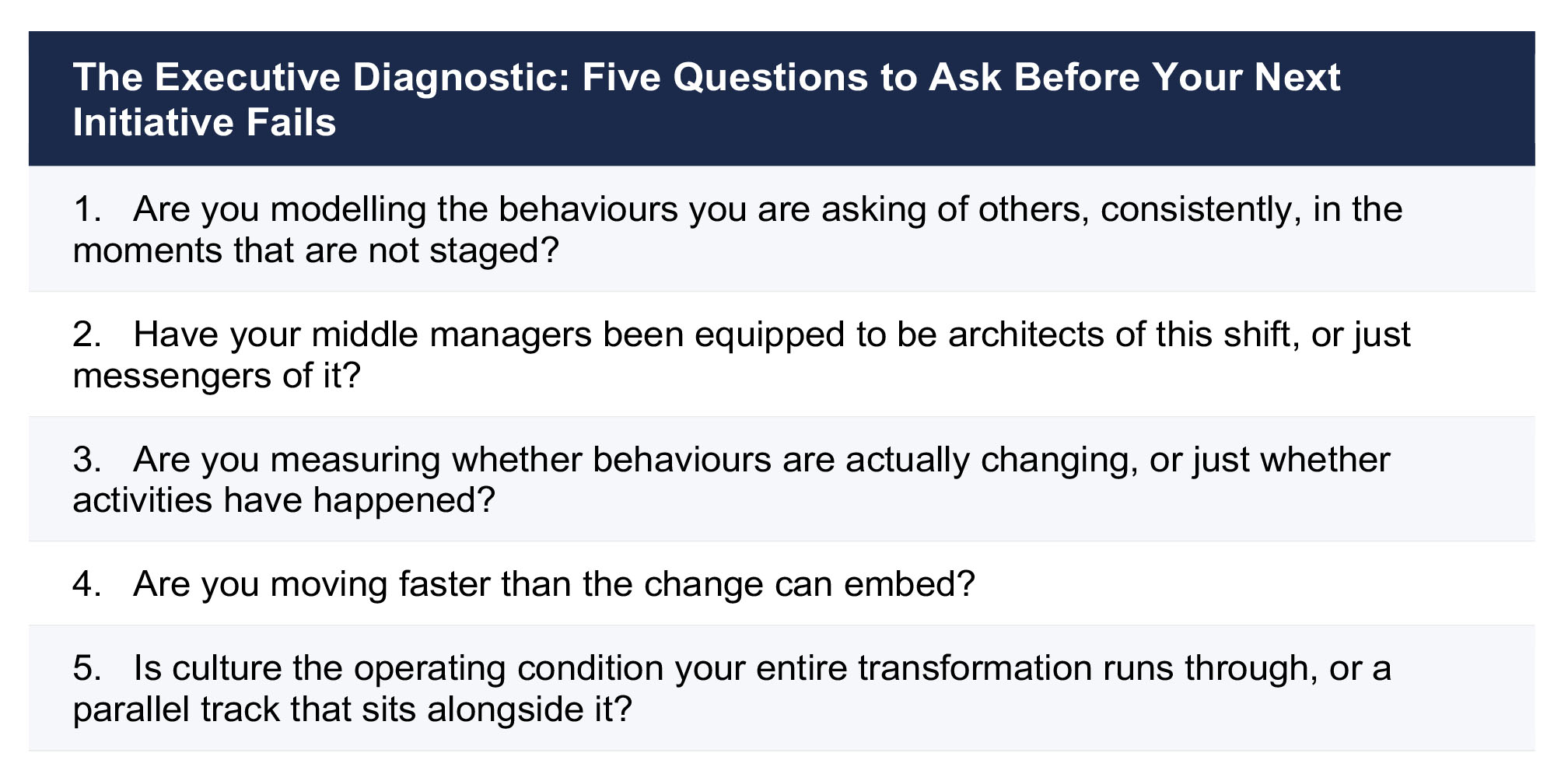
Five failure patterns appear with remarkable consistency across cultural transformation attempts:
1. Leadership commitment gaps, present in 75 percent of failed initiatives, where leaders focus on structural changes rather than modeling the behaviors they are asking of others. Transformations are five times more likely to fail when leaders do not consistently demonstrate the desired behaviors themselves.
2. Middle management neglect, the managers closest to the daily experience of the culture are treated as messengers of change rather than as architects of it. The message reaches people, but the environment does not shift.
3. Measuring activity rather than cultural movement, tracking the number of workshops run or communications sent, rather than whether behaviors and decision-making patterns are actually changing.
4. Moving too quickly through phases before the change has embedded, underestimating how long it takes for new behaviors to become the norm rather than the exception.
5. Treating culture as a parallel work stream rather than as the operating condition that all other strategic work runs through.
Run this diagnostic against your own organization before reading further:
How to Assess Your Organizational Culture
The starting point for a cultural shift that holds is an honest diagnosis of where the current culture actually is, not where leadership believes it to be, or wishes it were. These are often very different things, and the gap between them is itself a critical piece of data.
Senior leaders typically have a more optimistic view of the cultural environment than people further down the organization. When that gapis large, it signals that the culture’s surface narrative and its lived reality have diverged, one of the most reliable predictors of failed transformation.
The diagnostic cuts across three lenses:
What does the current culture actively support?
These are the elements to name explicitly, build on, and protect through the transition. Every organization has cultural strengths worth preserving, and a clear-eyed diagnosis surfaces them.
What does the current culture actively resist?
These are the specific behaviors, norms, and decision-making patterns that will undermine the strategy if left unaddressed. Naming these honestly is the hardest and most important part of the diagnostic exercise.
What is the culture genuinely neutral on?
These areas require monitoring rather than intervention, they will take their cue from what happens around them.
One critical discipline: the diagnostic must include the leadership team’s own behavioral patterns as a primary data point, not an after thought. The most revealing question in any cultural diagnosis is not‘What is the culture doing?’ but ‘What am I personally doing that is reinforcing it?’
In most countries, this diagnostic carries additional complexity. Organizations are simultaneously navigating national transformation agendas and significant shifts in workforce composition as nationalization program accelerate. Culture is not a single thing to be changed uniformly, different teams, functions, and generations within the same organization hold different lived experiences of what the culture actually is.A cultural shift that assumes a single starting point will be addressing a culture that does not exist.
The regional data below makes this challenge concrete. With the Middle East and North Africa ranking ninth globally on employee engagement at just 14 percent, well below the global average of 20 percent, the gap between the cultural environment organizations aspire to and what employees actually experience is not a perception problem. It is a measurable reality that strategic cultural work must address directly.
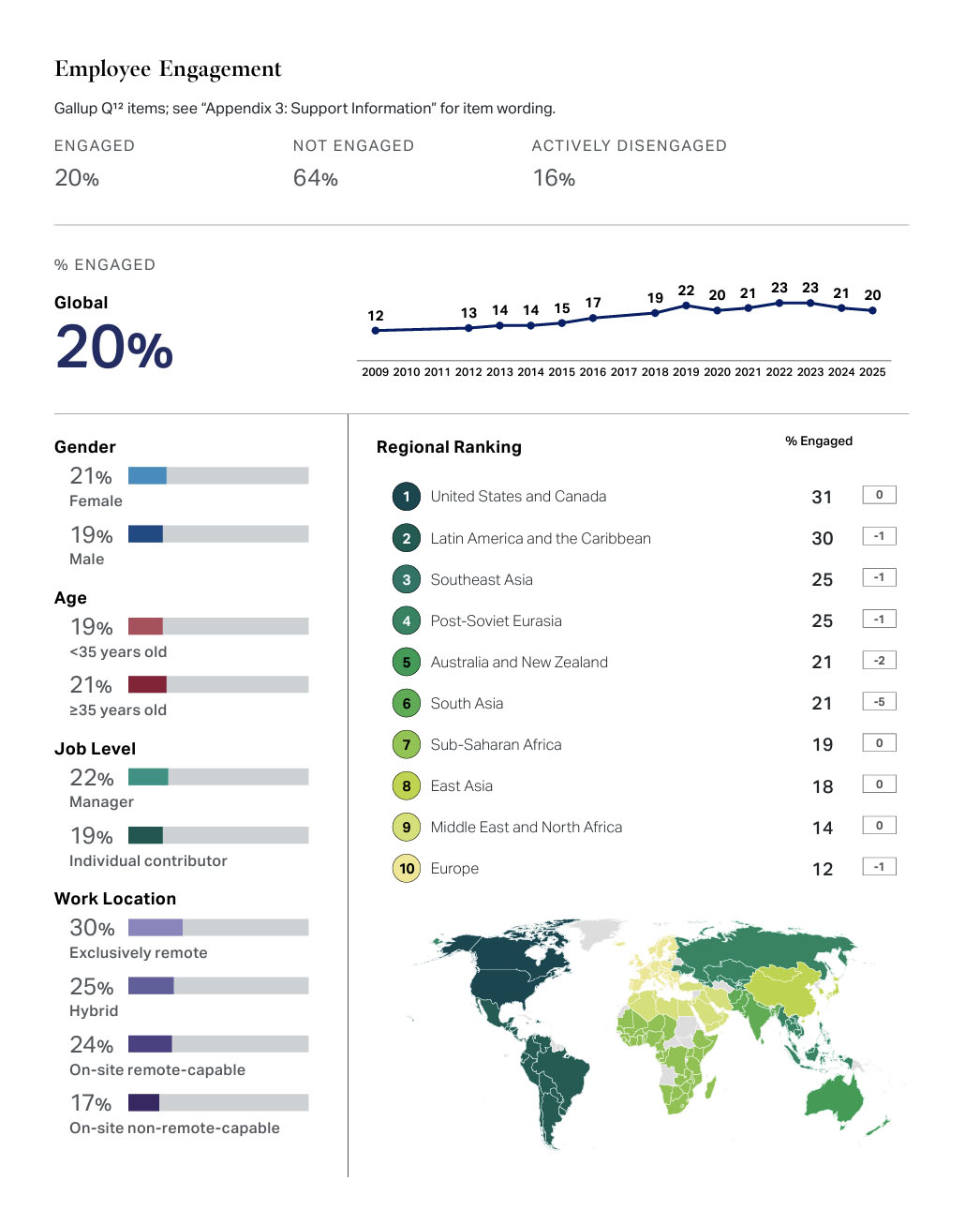
GRAPHIC 2:Gallup State of the Global Workplace 2026 Report, Page 18: Regional Ranking showing Middle East and North Africa at 14% employee engagement, ranked 9th globally out of 10 regions, against a global average of 20%
Building a High-Performance Organizational Culture
Once the diagnosis is complete, the next critical work is articulation, translating cultural intent into a framework specific enough to actually guide daily behavior. This is where most cultural initiatives stop short, and where the real leverage lies.
The most effective cultural frameworks follow a deliberate three-level architecture. Each level is necessary. None is sufficient on its own:
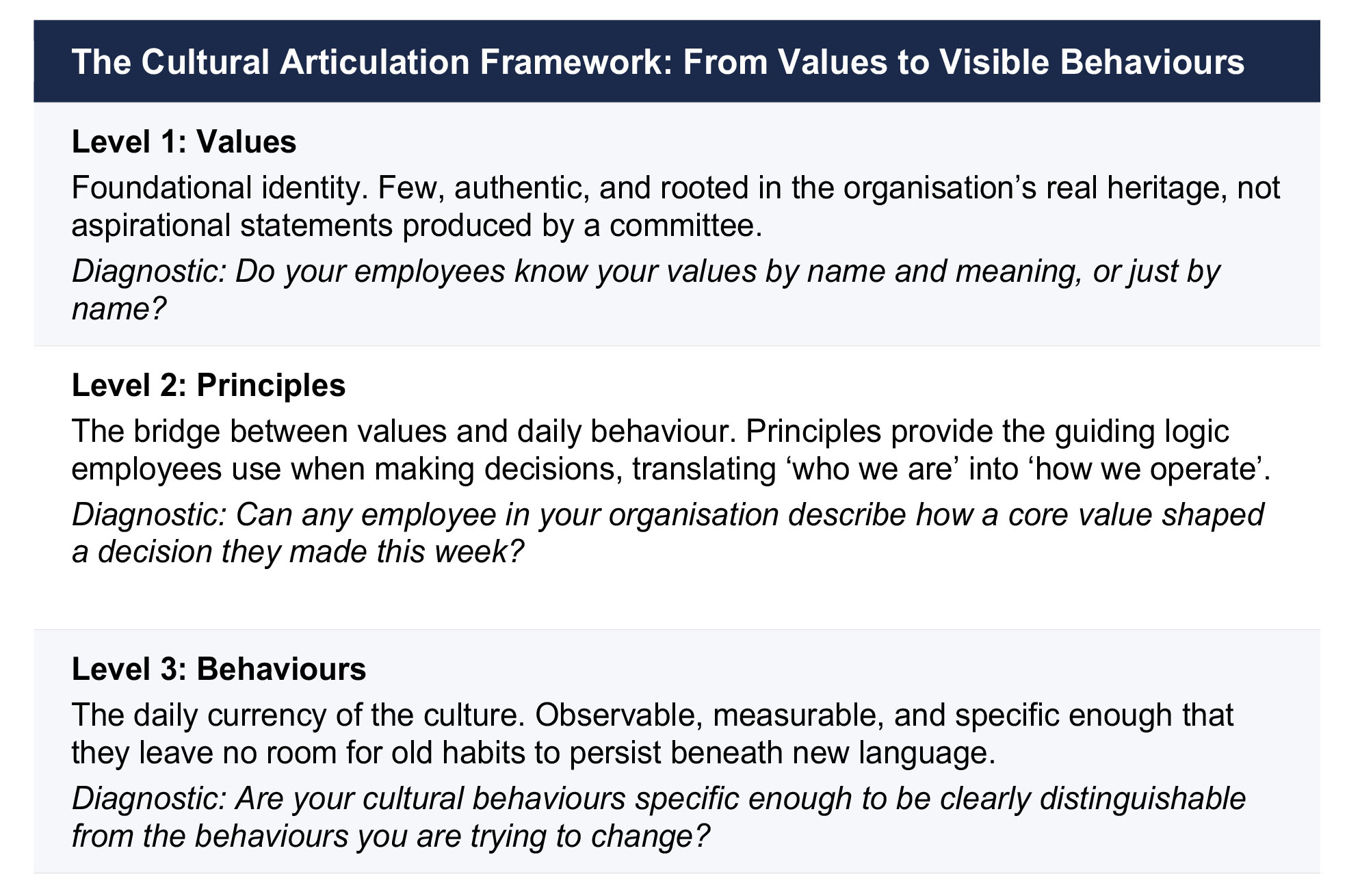
The failure of most cultural articulation efforts is that they stop at Level 1. Values get defined, communicated, and displayed, and the organization considers the work done. It is not. Values without principles are interpretable in any direction. Principles without behaviors are asprational at best. Culture becomes real only when behaviors are specific enough to require no translation.
What distinguishes the organizations that get this right is their commitment to co-creation: involving employees at every level in defining what the principles and behaviors actually look like in their context. A behavior defined exclusively by the executive team and communicated downward will be received as instruction. A behavior shaped through genuine engagement across the organization will be received as a shared commitment. The difference in ownership, and therefore in execution, is the difference between compliance and conviction.
Three Leadership Levers That Drive Culture Transformation
Defining the cultural framework is only the beginning. The harder work is making it real inside the organization. The organizations that succeed at this operate all three of the following levers simultaneously.
Lever 1 - The HumanArchitecture
Culture is carried by people, rituals, and symbols, and the informal elements of organizational life are more powerful cultural transmitters than any formal program. How leaders show up in everyday moments, what stories get told and retold, what behaviors get recognized in the moment rather than only at annual review time, these signals define what the culture actually values far more powerfully than any stated values document. Shifting culture requires deliberately redesigning these informal signals, not just the formal ones.
Lever 2 - The SystemArchitecture
Culture must be supported by systems. Performance management frameworks, decision rights, promotion criteria, how conflict is handled, how resources are allocated, these are the mechanisms that create real consequences for behavior. When the formal systems contradict the desired culture, the systems win. Every time. A meaningful cultural shift requires an honest audit of whether the organization’s formal architecture is aligned with or working against the direction it is trying to move in. If the new culture asks for collaboration but the reward system continues to recognize individual performance above all else, the reward system will always win.
Lever 3 - The ManagerLayer
This is the most consistently underestimated lever, and the evidence for its importance is unambiguous. Gallup’s research confirms that managers drive 70 percent of the variance in how employees experience culture on a daily basis. They are not intermediaries between leadership intent and frontline reality. They are the primary architects of that reality.
The critical question to ask about your middle management layer: do they have the clarity, tools, and confidence to own and champion the cultural direction you are trying to create? In most organizations that have attempted cultural transformation, the honest answer is no. Middle managers are asked to deliver against operational targets, navigate organizational complexity, and simultaneously lead a cultural shift, often with minimal preparation and no shared language for what the shift actually looks like in their context. Closing the gap requires targeted investment in the manager layer: shared language for what the cultural direction looks like in their specific context, practical tools for embedding new behaviors in daily team interactions, and accountability that includes cultural outcomes alongside operational targets.
“Managers drive 70 percent of the variance in team engagement. They are not just communicators of culture. They are its most powerful architects.” Gallup, State of the Global Workplace 2026
The Uncomfortable Truth About Leadership Behavior
The most important thing a senior leader can do to make a cultural shift real is also the most uncomfortable: change their own behavior visibly and first. Not symbolically, in a carefully staged moment, but genuinely, in the daily texture of how they run meetings, respond to disagreement, allocate their time, and react when the culture they are trying to build bumps up against the pressure of short-term performance.
Culture is not transmitted through communication. It is transmitted through observation. People in organizations watch their leaders closely and draw conclusions about what the culture actually values based on what they see rather than what they are told. When a leader says they value transparency but reacts badly to hearing difficult truths, the culture registers the behavior, not the statement. When a leader says they value collaboration but continues to make decisions unilaterally, the culture registers the decision-making pattern, not the espoused value.
Any cultural shift that does not start with an honest assessment of whether senior leaders’ own behaviors are consistent with the desired culture is starting in the wrong place. The behavioral consistency audit is a practical corrective, applied not once, but regularly:
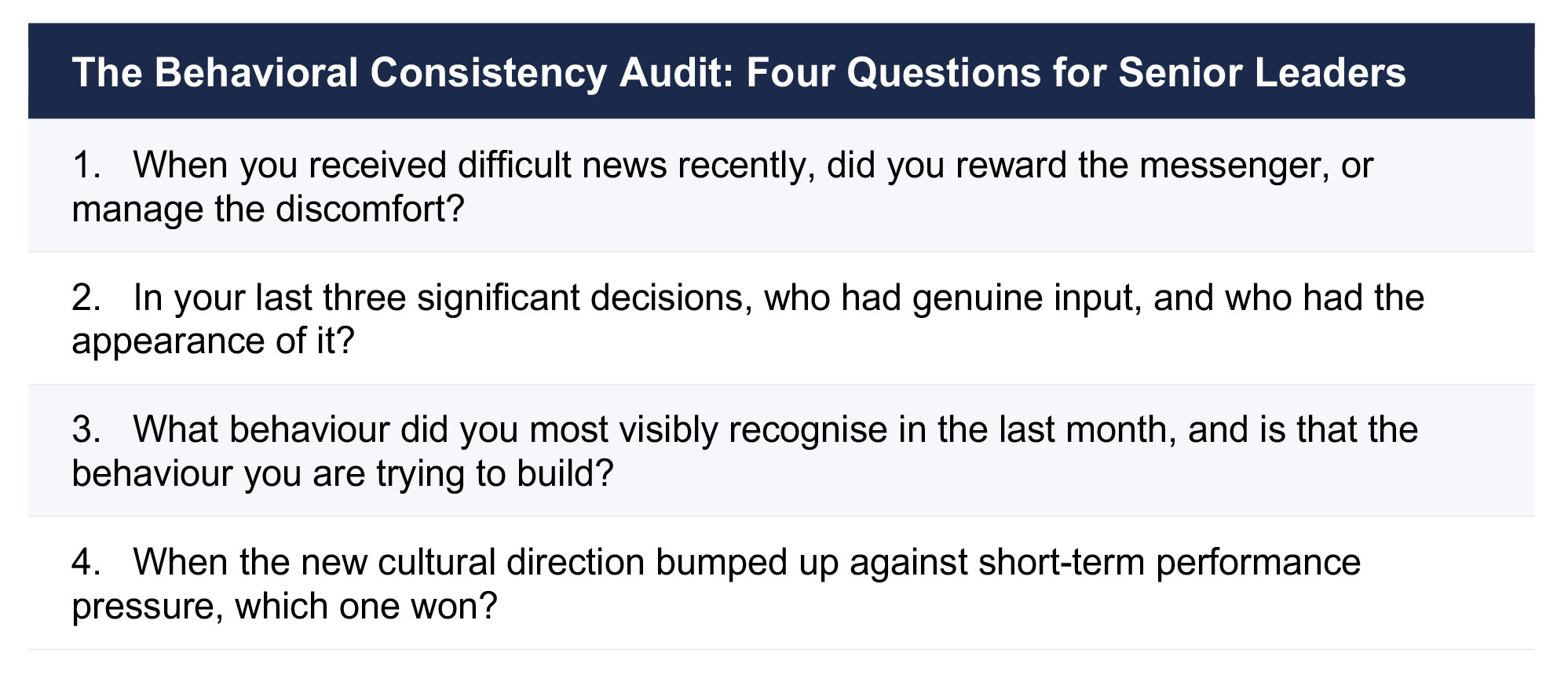
These are not rhetorical questions. They are the data points that define the culture as your people actually experience it, more honestly than any engagement survey.
What This Means for Global Leaders Right Now
For People and Culture leaders worldwide, the cultural shift challenge carries three specific dimensions. Most global organizations are currently navigating the intersection of three simultaneous forces: the behavioral and structural requirements of national transformation agendas, the workforce composition shifts driven by nationalization program, and the generational expectations of a younger workforce that holds fundamentally different assumptions about leadership, voice, and recognition than the generation above them.
Each creates genuine cultural pressure. National transformation agendas require organizations to move faster, take more risk, and operate with more agility than their existing cultures were designed to support. This is not a communications challenge, it is a cultural redesign challenge. Nationalization program are bringing new cohorts of talent into organizations at pace, and the cultural integration of those cohorts, making them feel genuinely included and capable rather than numerically present, is a challenge that sits squarely in the cultural domain.
Younger employees hold higher expectations, for manager quality, for recognition, and for a sense of meaning and ownership in their work. An organization’s culture either meets those expectations or loses the talent it invested in developing. In the context of nationalization transformation agenda, the ability to build cultures that genuinely engage and retain national talent is not a human resources metric. It is a national priority.
Best-practice organizations globally sustain manager engagement at 79 percent. The global average sits at 22 percent. That is not a marginal difference. It is a chasm, and it represents the distance between organizations where culture actively drives strategy and those where it quietly undermines it.
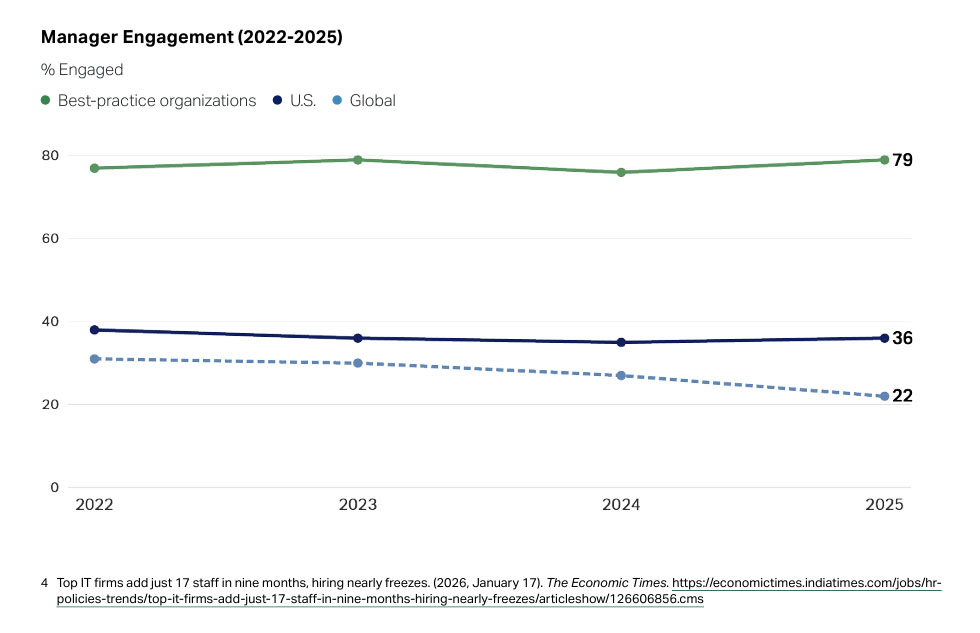
GRAPHIC 3: Gallup State of the Global Workplace 2026 Report, Page 8: Manager Engagement 2022-2025 showing best-practice organizations sustained at 79% versus global average declining to 22%
For Global Leaders investing in national transformation, closing that gap is not a People and Culture initiative. It is a strategic imperative.
The Work ThatActually Sticks
The organizations that emerge with cultures genuinely aligned to their strategy are not those that ran the best workshops or developed the most compelling culture narrative. They are those that did the harder, less visible work: diagnosing honestly, building a clear cultural architecture from values to visible behaviors, redesigning the systems and informal signals that drive daily choices, and developing the managers who carry the culture in their hands every day, until new behaviors become the norm rather than the exception.
That is not a one-cycle initiative. It is a sustained leadership commitment, and it begins with a decision that only the senior leadership team can make: to treat culture not as a supporting work stream, but as the terrain that every other strategic initiative has to navigate.
Organizations that consistently outperform their competitors understand that organizational culture, organizational design, and strategy execution are inseparable. Sustainable organizational transformation happens when leadership behaviors, organizational systems, and employee experiences all reinforce the same strategic direction. Culture is not a supporting initiative. It is the foundation of long-term organizational effectiveness.
Ready to Transform Your Organizational Culture?
Whether your organization is improving strategy execution, redesigning its operating model, strengthening leadership capability, or leading a large-scale organizational transformation, Caliber Consulting helps organizations align strategy, structure, leadership, and culture to deliver measurable business results.
Our consultants work with organizations worldwide to improve organizational effectiveness, accelerate change management, and build high-performing organizations equipped for sustainable growth.
Contact Caliber Consulting today to learn how our expertise in organizational design, organizational development, and culture transformation can help your organization turn strategy into lasting performance.
Explore our consulting services and executive masterclasses: https://www.caliber-consulting.com/masterclass